
Every domain name registered on the internet has associated registration information. These records can help identify the domain registrar, registration dates, domain status, and name servers responsible for directing internet traffic.
With a WHOIS lookup, you can retrieve publicly available registration information about a domain name. Modern lookup services, including the OffSecPath tool, use RDAP (Registration Data Access Protocol) to retrieve structured domain registration records through official protocols.
Whether you are researching a website, checking when a domain expires, investigating a suspicious domain, or verifying registration details, a lookup can provide useful information in seconds.
Best of all, the free OffSecPath WHOIS Lookup tool lets you check available domain registration details online without manually searching through registration databases.
What Is a WHOIS Lookup?
A WHOIS lookup retrieves available domain registration information from registration data services. In other words, it helps you find details associated with a registered domain name.
When someone registers a domain, the registrar collects registration information and maintains records associated with it. Depending on the domain extension, registrar, registry, and applicable privacy rules, some of these details may be publicly accessible.
A WHOIS lookup can help you discover details such as:
- Domain registration and creation date
- Domain expiration date
- Last updated date
- Domain registrar
- Domain status codes
- Name servers
- Registrant or organization information, when publicly available
- Registration authority and registry information
For example, a lookup can help you identify the registrar, check registration dates, review domain status codes, and inspect assigned name servers. However, personal information may be hidden or redacted because of privacy protection services and data protection requirements.
However, not every registration record exposes the domain owner’s personal information. Privacy protection services and data protection requirements may hide or redact identifying details.
What Is RDAP?
RDAP stands for Registration Data Access Protocol. It is a modern protocol that provides structured access to internet registration information.
RDAP was developed as a modern alternative to traditional WHOIS services. While WHOIS commonly returns plain-text records with inconsistent formatting, RDAP uses standardized responses, typically in JSON format.
This makes registration information easier for applications and tools to process.
RDAP also supports features such as:
- Standardized data structures
- Internationalization support
- Secure access through HTTPS
- Better identification of registration entities
- More consistent responses across supported services
- Access controls and differentiated data visibility
RDAP is particularly important for generic top-level domains because ICANN has been transitioning registration data services toward RDAP.
WHOIS vs RDAP: What Is the Difference?
Although WHOIS remains widely recognized, many domain lookup services still support it alongside newer technologies. In comparison, RDAP offers a more consistent and structured format for accessing registration information.
| Feature | WHOIS | RDAP |
|---|---|---|
| Data format | Primarily plain text | Structured JSON |
| Standardization | Historically inconsistent | Standardized responses |
| Access method | Traditionally TCP-based | HTTPS |
| Internationalization | Limited and inconsistent | Better support |
| Data access controls | Varies by service | Supports differentiated access |
| Modern development | Legacy protocol | Modern replacement |
WHOIS remains widely recognized and may still be available through various domain lookup services. RDAP is the newer approach and provides a more consistent format for accessing registration information.
Depending on the domain extension and available registration services, a modern lookup tool may use traditional WHOIS, RDAP, or both. Therefore, the protocol used can vary from one domain to another.
What Information Can You Find With a WHOIS / RDAP Lookup?
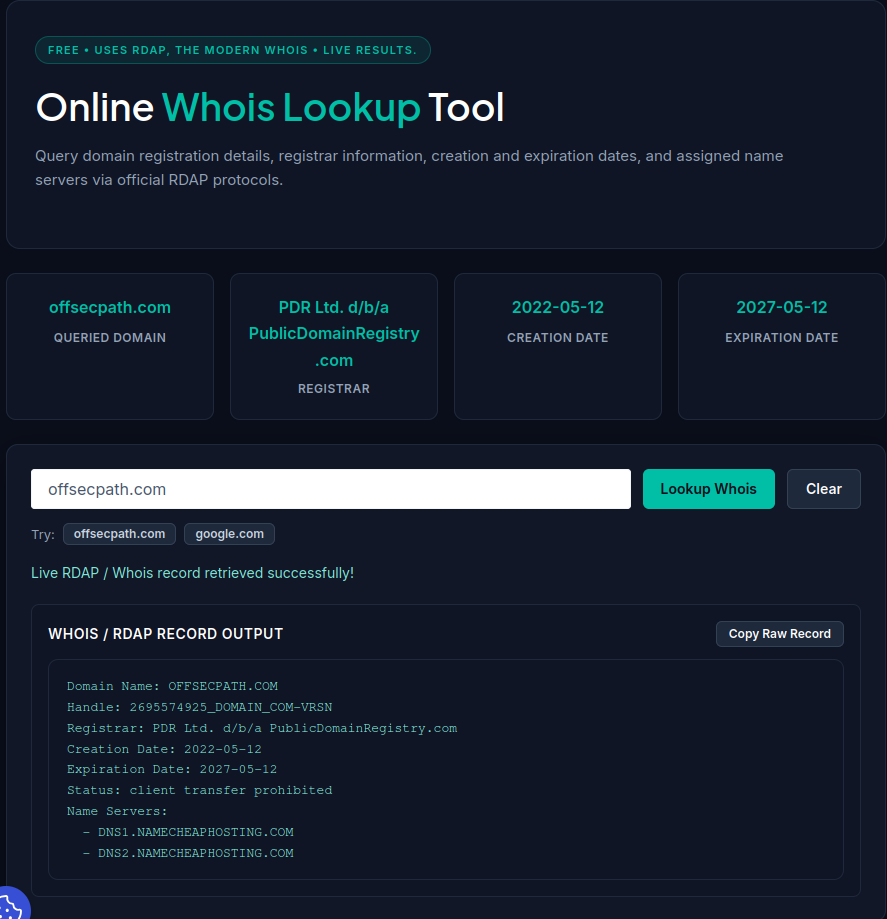
The exact information returned depends on the domain registry, registrar, and privacy settings. However, a domain registration lookup commonly provides several useful fields.
1. Domain Name
This identifies the domain being queried.
For example:
example.com
The domain name helps confirm that you are viewing registration information for the correct website.
2. Registrar Information
The registrar is the company through which the domain name was registered.
A registration record may include:
- Registrar name
- Registrar identification number
- Registrar website
- Registrar contact information
This information can help you identify which provider manages the domain registration.
3. Domain Creation Date
The creation date indicates when the domain registration was first recorded.
This can help you estimate how long a domain has existed.
For example, when investigating an unfamiliar website, a recently registered domain may deserve additional scrutiny. However, a new registration does not automatically mean that a website is fraudulent or unsafe.
4. Domain Expiration Date
The expiration date indicates when the current registration period is scheduled to end.
Domain owners generally need to renew their registrations to maintain control of their domains.
An expiration date does not always mean that the domain will immediately become available to the public. Registrars and registries may provide renewal periods, grace periods, or other lifecycle stages.
5. Last Updated Date
This indicates when the registration record was last modified.
Changes may include registrar updates, name server modifications, contact information changes, or other registration updates.
The exact meaning of an update depends on the registry’s reporting practices.
6. Domain Status Codes
Domain status codes describe the current registration or operational state of a domain.
Some common examples include:
| Status Code | Meaning |
|---|---|
| clientTransferProhibited | The registrar has restricted domain transfers. |
| clientUpdateProhibited | The registrar has restricted certain domain updates. |
| clientDeleteProhibited | The registrar has restricted domain deletion. |
| serverTransferProhibited | The registry has restricted domain transfers. |
| serverUpdateProhibited | The registry has restricted certain domain updates. |
| serverDeleteProhibited | The registry has restricted domain deletion. |
| pendingDelete | The domain is in a deletion-related lifecycle stage. |
These status codes are not necessarily indicators of a problem. Many domains use transfer or update restrictions as routine protection against unauthorized changes.
7. Name Servers
Name servers identify the DNS servers associated with a domain.
They help direct DNS queries to the correct DNS infrastructure.
For example, a domain registration record may show name servers such as:
ns1.example.com
ns2.example.com
Name server information can help administrators and researchers understand which DNS infrastructure a domain uses.
However, name servers do not reveal every DNS record associated with a domain. For that, you may need a dedicated DNS lookup tool.
8. Registrant Information
Some domain records may include information about the registrant, such as:
- Organization name
- Country
- Contact details
- Administrative contact information
However, many registrars offer WHOIS privacy protection or redact personal information from public records.
Therefore, a WHOIS lookup cannot guarantee that you will discover the real-world identity of a domain owner.
How to Perform a WHOIS / RDAP Lookup Online
You can check domain registration information using the free OffSecPath WHOIS Lookup tool.
Follow these steps:
- Open the OffSecPath WHOIS Lookup tool.
- Enter the domain name you want to investigate.
- Start the lookup.
- Wait for the registration information to load.
- Review the available domain details, including registrar, registration dates, domain status, and name servers.
The information displayed depends on the registration data available for the domain.
You can repeat the process with other domain names whenever you need to investigate additional websites.
Why Is WHOIS Lookup Useful?
WHOIS and RDAP lookups are useful for website owners, developers, cybersecurity professionals, researchers, and ordinary internet users.
Here are some common situations where domain registration information can help.
1. Checking Domain Registration Details
Website owners can use WHOIS lookup to review registration dates, registrar information, and name servers associated with their domains.
This can help them confirm that a domain is registered with the expected provider.
2. Investigating Suspicious Websites
Before interacting with an unfamiliar website, you can examine its publicly available registration information.
For example, a recently registered domain with unusual characteristics may deserve further investigation.
However, registration age and registrar information alone cannot establish whether a website is malicious.
3. Cybersecurity Research
Security analysts and threat researchers may use domain registration information as one source of intelligence during an investigation.
It can help provide context about:
- Domain registration timelines
- Registrar relationships
- Name server infrastructure
- Domain status changes
- Available registration contacts
WHOIS and RDAP information should be combined with other sources, such as DNS records, certificate information, reputation databases, and passive DNS data, when conducting a broader investigation.
4. Checking Domain Expiration
Domain owners can inspect the reported expiration date to help manage renewal schedules.
This is particularly useful for organizations managing multiple domains.
Keep in mind that the date shown in a registration record may not reflect every renewal arrangement or registry lifecycle rule.
5. Researching Domain Ownership
When evaluating a business website or researching a domain, registration records may provide useful information about the registrar and any publicly available registrant details.
However, privacy protection and data redaction may prevent you from identifying the actual domain owner.
WHOIS Lookup vs DNS Lookup
WHOIS and DNS lookups are often used together, but they answer different questions.
| Feature | WHOIS / RDAP Lookup | DNS Lookup |
|---|---|---|
| Main purpose | Retrieve domain registration information | Retrieve DNS records |
| Registrar information | Yes, when available | No |
| Registration dates | Often available | No |
| Domain status | Often available | No |
| Name servers | Often available | Yes |
| IP address records | Not its primary purpose | Yes |
| MX records | No | Yes |
| TXT records | No | Yes |
A WHOIS lookup helps you understand domain registration information, while a DNS lookup helps you understand how a domain resolves and which DNS records it publishes.
If you want to investigate a website more thoroughly, using both types of lookup can provide a more complete picture.
Important Limitations of WHOIS and RDAP Lookups
Although domain registration lookups are useful, they have several limitations.
Privacy Protection Can Hide Owner Details
Many domain registrars offer privacy protection services. These services replace or redact personal registrant information in publicly accessible records.
As a result, you may see a privacy service or redacted fields instead of the actual owner’s name and contact details.
Not Every Domain Returns the Same Information
Different domain extensions use different registries and registration policies.
Some domain records may contain extensive information, while others expose only limited registration details.
Registration Data May Not Be Real-Time
Registration records can take time to reflect recent changes.
If a domain owner changes a registrar, name servers, or other registration details, the updated information may not appear immediately in every lookup service.
WHOIS Does Not Prove Website Legitimacy
A registered domain with a valid registrar and normal status codes is not automatically trustworthy.
Likewise, a recently registered domain is not automatically malicious.
Use registration information as one part of a broader website investigation.
Frequently Asked Questions (FAQs)
What is a WHOIS lookup?
A WHOIS lookup retrieves publicly available domain registration information, such as the registrar, creation date, expiration date, domain status, and name servers.
Is WHOIS lookup free?
Yes. You can use free online WHOIS lookup services to retrieve publicly available registration information. The information returned depends on the domain registry and applicable access policies.
What is the difference between WHOIS and RDAP?
WHOIS is the older domain registration lookup protocol, while RDAP is its modern alternative. RDAP uses structured JSON responses over HTTPS and provides more standardized access to registration data.
Can I find the owner of any domain name?
Not always. Some registrars use privacy protection services or redact personal information from public records. You may be able to see the registrar and other domain details without identifying the actual owner.
Can WHOIS show when a domain was registered?
Yes. Registration records commonly include a creation date, although the exact fields available depend on the domain registry and lookup service.
Can WHOIS show a domain’s expiration date?
Many registration records include an expiration date. However, the date does not necessarily indicate when the domain will become publicly available if it is not renewed.
Does WHOIS show a domain’s IP address?
WHOIS is primarily designed to provide registration information, not DNS resolution details. Use a DNS lookup tool to find the IP addresses associated with a domain.
Is WHOIS information always accurate?
Not necessarily. Records may be outdated, delayed, incomplete, or redacted. For important decisions, verify information through the relevant registrar or registry.
Can I use WHOIS lookup for cybersecurity research?
Yes. Security professionals use WHOIS and RDAP data as one source of domain intelligence. It can provide useful registration context, but it should be combined with other technical and reputation checks.
Related Free Tools
Explore more free tools on OffSecPath:
- WHOIS Lookup – Retrieve available domain registration information.
- JWT Decoder – Decode JSON Web Tokens and inspect their claims.
- Base64 Encoder and Decoder – Encode and decode Base64 text.
- Robots.txt Generator – Generate crawler access rules for your website.
- JSON Formatter and Validator – Format and validate JSON data.
Visit the OffSecPath All Tools directory to explore more free online utilities.
Also Read
- What Is a JSON Formatter and Validator? How to Format and Validate JSON Online
- Secure Password Generator: Create Strong Passwords Online
- Base64 Encoder and Decoder Online for Free
- HTML Entity Encoder and Decoder Online for Free
- Robots.txt Generator: How to Create a Robots.txt File Online for Free
Final Thoughts
A WHOIS / RDAP lookup is a useful way to investigate publicly available domain registration information. It can help you identify a registrar, review domain registration dates, inspect domain status codes, and check associated name servers.
Whether you are managing your own website, researching an unfamiliar domain, or performing basic cybersecurity reconnaissance, domain registration information can provide valuable context.
Try the free OffSecPath WHOIS Lookup tool to check available registration details for a domain name.